
What Is an AI Agent and How Is It Different From a Chatbot?
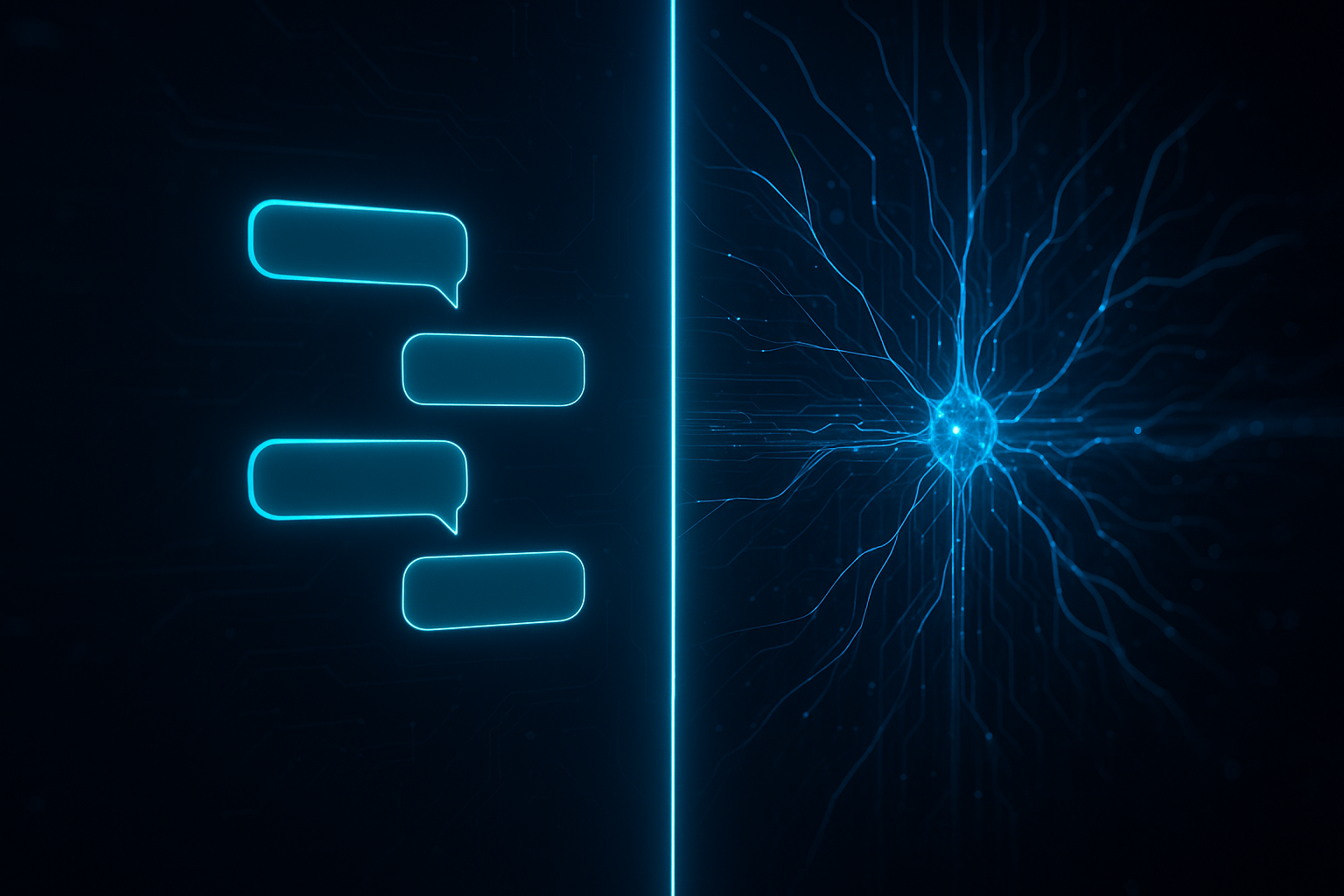
an ai agent is an autonomous system that can plan, make decisions, and take actions to achieve goals, while a chatbot simply responds to user inputs with pre-programmed or generated text. Unlike chatbots that react to prompts, AI agents proactively execute multi-step tasks, use tools, and adapt their strategies based on outcomes.
If you’ve used chatgpt to draft an email or asked Alexa to set a timer, you’ve interacted with AI. But there’s a meaningful difference between a chatbot that answers questions and an ai agent that actually does things for you. Understanding this distinction matters because we’re entering an era where AI doesn’t just respond—it acts, decides, and completes multi-step tasks without constant hand-holding. Here’s what separates agents from chatbots, and why that difference is reshaping how we work.
Chatbots: Conversational Responders
A chatbot is software designed to simulate conversation. You ask it something, it generates a response. That’s the loop.
Modern chatbots use large language models (LLMs) to understand natural language and produce coherent, context-aware replies. chatgpt, Claude, and Gemini are sophisticated chatbots. They’re excellent at explaining concepts, writing code snippets, brainstorming ideas, and answering questions based on their training data.
But chatbots are fundamentally reactive. They wait for your input, process it, and return output. They don’t take initiative. They don’t execute tasks in the real world. If you ask chatgpt to “book me a flight to Denver,” it might suggest airlines or draft a search query, but it won’t actually open a browser, compare prices, enter your credit card, and confirm the booking. It lacks agency.
AI Agents: Autonomous Task Executors
an ai agent is software that perceives its environment, makes decisions, and takes actions to achieve specific goals—often with minimal human intervention.
The key difference is autonomy and action. An agent doesn’t just tell you what to do; it does it. It can interact with tools, APIs, databases, and other software systems. It plans multi-step workflows, adapts when things go wrong, and operates in a loop: observe, decide, act, repeat.
Think of an ai agent as a digital employee with a narrow job description. You might tell it “monitor our competitors’ pricing and update our product pages when they drop below ours.” The agent checks competitor sites daily, detects changes, evaluates whether action is needed, and pushes updates to your CMS—all without you lifting a finger after the initial instruction.
Agents use LLMs for reasoning and language understanding, but they’re wrapped in additional logic: task planning, memory, tool use, and error handling. They’re not just conversational—they’re operational.
Key Differences: Chatbot vs. AI Agent
| Aspect | Chatbot | AI Agent |
|---|---|---|
| Primary function | Answer questions, generate text | Complete tasks, achieve goals |
| Autonomy | Reactive, waits for prompts | Proactive, can initiate actions |
| Tool use | Limited or none | Integrates with APIs, databases, software |
| Memory | Session-based, often stateless | Persistent memory across tasks |
| Decision-making | Responds to input | Plans, adapts, iterates |
A chatbot is a helpful assistant you talk to. An agent is a worker you delegate to.
How AI Agents Actually Work
Under the hood, most AI agents in 2026 follow a pattern called the ReAct framework (Reasoning + Acting). Here’s the simplified loop:
- Observe: The agent receives a goal or detects a trigger (a new email, a price change, a calendar event).
- Reason: It uses an LLM to break the goal into steps and decide what to do next.
- Act: It calls a tool—sends an API request, queries a database, writes to a file, clicks a button via browser automation.
- Evaluate: It checks the result. Did the action succeed? Does it need to adjust the plan?
- Repeat: It loops until the goal is met or it determines the task is complete (or impossible).
Agents often have access to a “toolbox”—a set of functions they can invoke. For a customer support agent, that might include: search the knowledge base, pull up order history, issue a refund, send an email. The LLM decides which tool to use and when, based on the context.
Memory is another critical component. Agents maintain state across interactions. They remember what they’ve tried, what worked, and what the user prefers. This makes them far more effective for ongoing workflows than one-off chatbot exchanges.
Real-World Examples of AI Agents in 2026
AI agents aren’t science fiction. They’re in production, handling real work:
-
Customer support agents: Companies like Intercom and Zendesk deploy agents that triage tickets, answer common questions by pulling from documentation, and escalate complex issues to humans—all in natural language across email, chat, and social media.
-
Sales and lead qualification: Agents monitor inbound leads, score them based on behavior and firmographics, send personalized follow-ups, and book meetings on your calendar. They don’t just draft the email—they send it and track replies.
-
Code generation and debugging: GitHub Copilot Workspace and similar tools act as coding agents. You describe a feature, and the agent writes the code, runs tests, debugs failures, and commits changes to version control.
-
Personal assistants: Tools like Lindy and Relay let you build agents that manage your inbox, schedule meetings, summarize Slack threads, or even negotiate with vendors on your behalf.
-
Data analysis: Agents ingest datasets, run statistical models, generate visualizations, and write reports—interpreting results and suggesting next steps without you writing a single line of code.
At masterai labs, we build tools like pulseiq, which monitors brand mentions and sentiment across the web. While not a fully autonomous agent, it automates the observe-analyze-alert loop, freeing teams from manual reputation tracking.
Who Are the Big 4 AI Agents?
When people ask about the “big 4 AI agents,” they’re usually referring to the major platforms or frameworks driving agent development in 2026. The landscape is fluid, but four names dominate:
-
OpenAI Assistants API: OpenAI’s agent framework lets developers build agents with persistent memory, code execution, and file handling. It’s the backbone for thousands of custom business agents.
-
Anthropic’s Claude with Tools: Claude excels at reasoning and tool use. Its extended context window and function-calling capabilities make it a favorite for complex, multi-step workflows.
-
Google’s Gemini Agents: Google integrated agent capabilities directly into Workspace and its Vertex ai platform. Gemini agents handle everything from email triage to supply chain optimization.
-
Microsoft Copilot Studio: Microsoft’s low-code platform for building agents across Office, Dynamics, and Azure. It’s enterprise-focused, with deep hooks into the Microsoft ecosystem.
These aren’t consumer products you download. They’re platforms and APIs that power the agents you interact with—often invisibly—across SaaS tools, enterprise software, and custom applications.
When to Use a Chatbot vs. an AI Agent
Not every problem needs an agent. Chatbots are perfectly suited for:
- Information retrieval: “What’s our return policy?” or “how do i reset my password?”
- content generation: Drafting blog posts, writing marketing copy, generating code snippets.
- Brainstorming: Exploring ideas, outlining strategies, getting feedback on a concept.
Agents make sense when you need:
- Recurring workflows: Tasks you do daily or weekly that follow a predictable pattern.
- Multi-step processes: Anything requiring decisions across multiple tools or systems.
- Real-time monitoring: Watching for changes and responding automatically.
- Delegation, not consultation: You want the work done, not instructions on how to do it.
If you find yourself copy-pasting chatbot output into other tools, or running the same prompt repeatedly, you probably need an agent.
The Risks and Limitations of AI Agents
Agents are powerful, but they’re not foolproof. Giving software autonomy introduces new risks:
- Errors compound: A chatbot gives you bad advice, you catch it. An agent acts on bad reasoning, and you might not notice until damage is done.
- Security and access control: Agents need API keys, database credentials, and permissions. A compromised agent is a compromised system.
- Unpredictability: LLMs hallucinate. Agents can misinterpret instructions, call the wrong tool, or get stuck in loops.
- Cost: Agents make many LLM calls per task. A poorly designed agent can rack up API bills fast.
Best practice in 2026: start agents with narrow, well-defined tasks. monitor their actions. Use human-in-the-loop approval for high-stakes decisions. Treat them like junior employees—capable, but needing oversight.
The Future of Chatbots and Agents
The line between chatbots and agents will blur. Chatbots are gaining tool-use capabilities. Agents are getting better conversational interfaces. Eventually, you’ll interact with a single AI system that can both answer your questions and execute tasks—switching modes fluidly based on what you need.
We’re also seeing multi-agent systems, where specialized agents collaborate. One agent handles research, another drafts content, a third publishes and tracks performance. Orchestration layers coordinate their work, much like a team of people with different roles.
The chatbot-to-agent spectrum is the new way to think about AI capabilities. On one end: pure conversation. On the other: full autonomy. Most useful AI in 2026 lives somewhere in the middle.
Frequently Asked Questions
What are the top 5 AI agents?
The top platforms enabling AI agents in 2026 are OpenAI’s Assistants API, Anthropic’s Claude with function calling, Google’s Gemini Agents, Microsoft Copilot Studio, and LangChain (an open-source framework for building custom agents). These aren’t standalone products but ecosystems powering thousands of specialized agents across industries. The “best” agent depends on your use case—customer support, coding, data analysis, or workflow automation.
The Bottom Line
A chatbot talks. An AI agent acts. Chatbots are excellent for generating text, answering questions, and brainstorming—they’re conversational tools. AI agents go further: they plan, decide, use tools, and complete tasks autonomously. As agents become more reliable and accessible, the question shifts from “what can AI tell me?” to “what can AI do for me?” Understanding this distinction helps you deploy the right tool for the job—and avoid expecting your chatbot to do an agent’s work.
Our AI Tools
See all our apps →📚 Free: Get Found by AI — the 2026 GEO Playbook
Get the free ebook on how to get your brand cited by the AI Claude, Gemini & Perplexity — plus new posts as we publish them.
No spam. Unsubscribe anytime in one click.