What Is Retrieval-Augmented Generation (RAG) and When Should You Use It
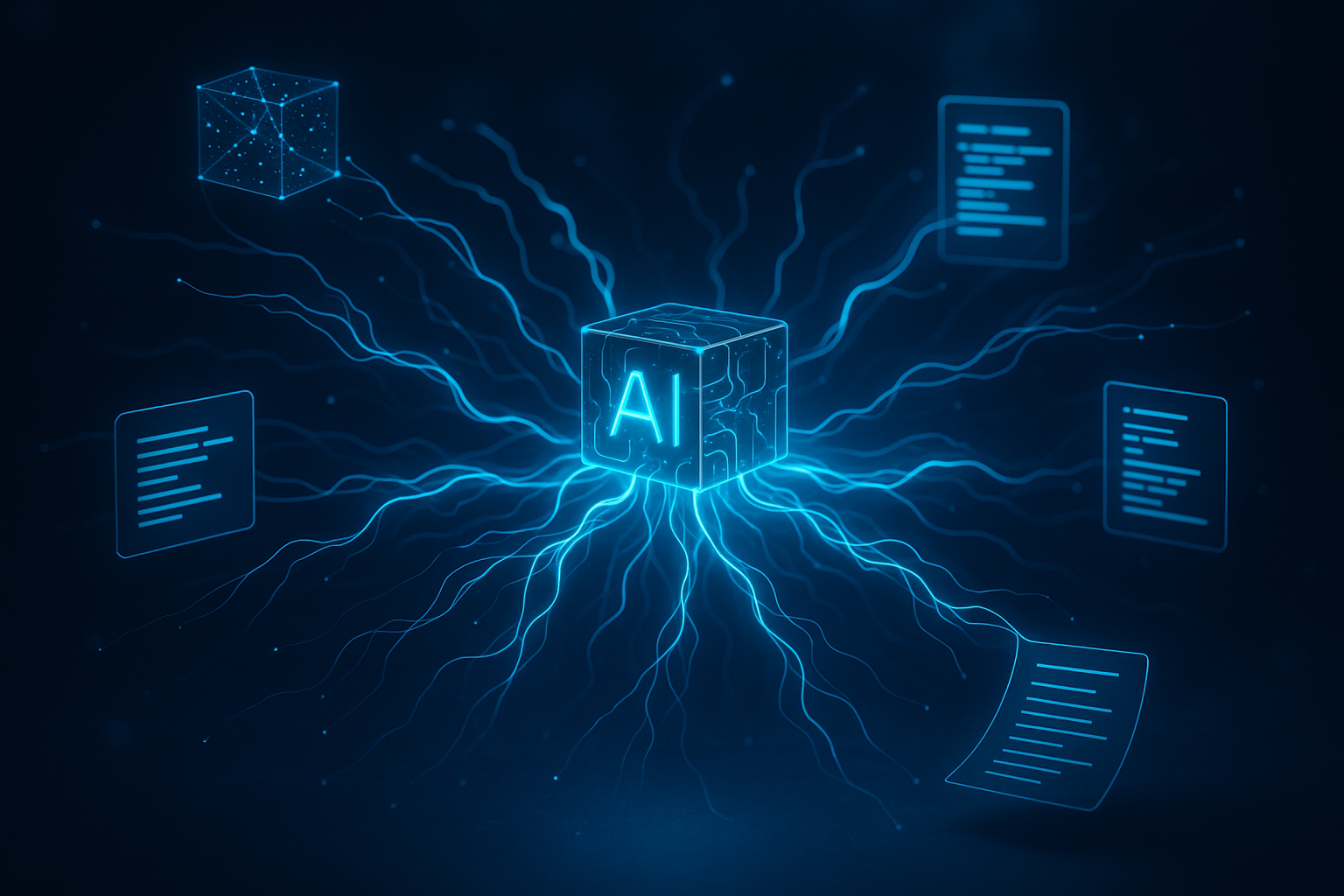
Retrieval-Augmented generation (RAG) is a technique that combines large language models with external knowledge retrieval to provide accurate, up-to-date responses. You should use RAG when you need AI to access current information, proprietary data, or domain-specific knowledge that wasn’t included in the model’s original training data.
large language models are impressive, but they have a fundamental problem: they only know what they learned during training. Ask GPT-4 about your company’s internal documents, last week’s sales data, or a niche technical spec from 2025, and it draws a blank. Retrieval-augmented generation fixes this by letting AI pull in external information before generating an answer. Here’s what RAG actually is, how it works, and when it makes sense to use it.
What Retrieval-Augmented generation Actually Means
RAG is a technique that combines two things: a retrieval system that finds relevant information, and a generative AI model that uses that information to produce an answer.
Think of it like an open-book exam versus a closed-book exam. A standard LLM is taking a closed-book test—it can only work with what it memorized during training. RAG lets the model consult external sources first, then answer based on what it just read.
The process works in three steps. First, when you ask a question, the system converts it into a numerical representation (an embedding) and searches a database of documents for the most relevant chunks. Second, it retrieves those chunks—maybe three paragraphs from different support articles, or sections from recent reports. Third, it feeds both your question and the retrieved context into the LLM, which generates an answer grounded in that specific information.
This matters because training an LLM is expensive and slow. You can’t retrain GPT-4 every time your product documentation changes. RAG lets you keep the model frozen while updating the knowledge it can access.
The 4 Levels of RAG Implementation
Not all RAG systems are created equal. The field has evolved from simple keyword matching to sophisticated multi-step reasoning. Here are the four levels, from basic to advanced.
Level 1: Naive RAG
This is the straightforward approach most people start with. You chunk your documents into passages, create embeddings for each chunk, store them in a vector database, and retrieve the top matches when someone asks a question.
It works, but it’s crude. If your question uses different terminology than your documents, retrieval fails. If the answer requires combining information from multiple sources, you might not get the right chunks. And if your chunks are poorly sized—too small and they lack context, too large and they dilute relevance—quality suffers.
Level 2: Advanced RAG
Level 2 adds pre-processing and post-processing to improve accuracy. Before retrieval, you might rephrase the user’s question, expand it with synonyms, or break complex queries into sub-questions. after retrieval, you might rerank the results using a more sophisticated model, filter out low-confidence matches, or compress the context to fit token limits.
This is where most production RAG systems operate in 2026. You’re still doing one retrieval pass, but you’re being smarter about how you search and what you feed the LLM.
Level 3: Modular RAG
At this level, RAG becomes a flexible pipeline where you can swap components and add specialized modules. You might route different types of questions to different retrieval strategies—semantic search for conceptual queries, keyword search for specific terms, SQL queries for structured data.
You can also add memory, letting the system track conversation history and retrieve based on context from earlier exchanges. Or you might implement query decomposition, where a complex question gets broken into simpler sub-questions that are answered separately and then synthesized.
Level 4: Agentic RAG
The most advanced form treats RAG as part of an autonomous agent workflow. The system doesn’t just retrieve once—it reasons about what information it needs, retrieves it, evaluates whether it has enough, and decides whether to search again or try a different approach.
An agentic RAG system might realize mid-answer that it needs additional context, formulate a follow-up query, retrieve more documents, and integrate everything into a coherent response. It can also use tools: calling APIs, running calculations, or querying databases as needed.
This level is still emerging but shows up in research assistants, advanced chatbots, and systems that need to handle open-ended tasks with minimal human guidance.
When RAG Makes Sense (And When It Doesn’t)
RAG shines in specific scenarios. use it when you need an LLM to work with information that changes frequently—customer support documentation, internal wikis, product catalogs, or real-time data feeds. It’s also essential when you need transparency: RAG systems can cite sources, letting users verify answers.
It’s particularly valuable for domain-specific applications. A legal research tool needs to reference actual case law. A medical chatbot should pull from current treatment guidelines. A customer service bot needs to know your return policy as it exists today, not as it was when the model was trained.
RAG also helps with hallucination reduction. By grounding answers in retrieved text, you constrain the model to work with facts rather than confabulating plausible-sounding nonsense.
But RAG isn’t always the answer. If your use case involves general knowledge that doesn’t change—writing marketing copy, brainstorming ideas, explaining common concepts—a standard LLM works fine and runs faster. If your data is small and static, fine-tuning might be simpler. And if you need the model to genuinely learn patterns from your data rather than just reference it, fine-tuning or continued pre-training is the right approach.
RAG also adds latency and complexity. You’re running a search query, retrieving documents, and processing more tokens. For high-volume applications where milliseconds matter, this overhead can be a problem.
Building a RAG System: The Core Components
If you decide RAG is right for your use case, you’ll need several pieces.
Document processing is the foundation. You need to ingest your source material, split it into chunks (usually 200-500 tokens), and handle different formats—PDFs, HTML, databases, APIs. Poor chunking ruins everything downstream.
Embedding models convert text into vectors. OpenAI’s text-embedding-3 models are common choices, but specialized embeddings for specific domains can improve retrieval accuracy.
vector databases store and search embeddings efficiently. Pinecone, Weaviate, Qdrant, and Chroma are popular options. For smaller projects, even PostgreSQL with the pgvector extension works.
Retrieval strategies determine what you fetch. Semantic search finds conceptually similar content. Hybrid search combines semantic and keyword matching. Metadata filtering lets you narrow results by date, category, or other attributes.
LLM integration is where retrieval meets generation. You construct a prompt that includes the user’s question and the retrieved context, then feed it to your model. prompt engineering matters here—you need to instruct the model to stick to the provided context and admit when it doesn’t know.
Common RAG Pitfalls and how to Avoid Them
The most frequent mistake is assuming retrieval will always work. It won’t. If your documents use jargon or abbreviations that don’t match user queries, semantic search struggles. Solution: use query expansion, add metadata, or maintain a synonym list.
Another issue is context window management. Retrieving ten long documents might exceed your LLM’s token limit or bury the relevant information in noise. Retrieve fewer, higher-quality chunks. Use reranking to surface the best matches.
Stale data is a silent killer. If your vector database isn’t updated when source documents change, users get outdated answers. Build automated pipelines to re-index content regularly.
And don’t ignore evaluation. You need to measure retrieval accuracy (are you finding the right documents?) and generation quality (are the answers correct and useful?). track metrics like precision@k for retrieval and user feedback for end-to-end quality.
RAG in Production: What Actually Works
after two years of widespread RAG adoption, some patterns have emerged. Hybrid search—combining dense vector search with traditional keyword search—consistently outperforms pure semantic search for most applications. users don’t always phrase queries the way documents are written, and keyword matching catches exact terms that embeddings might miss.
Smaller, more frequent chunks generally beat larger ones. A 300-token chunk with tight topical focus retrieves better than a 1000-token chunk covering multiple ideas. You lose some context, but you gain precision.
Metadata filtering is underused but powerful. If you tag documents with dates, departments, or categories, you can dramatically improve retrieval by narrowing the search space before doing semantic matching.
And simple often wins. Before building a complex multi-step agentic system, make sure your basic retrieval and prompting work well. Most RAG failures come from poor chunking or weak retrieval, not from lack of sophisticated orchestration.
Frequently Asked Questions
What are some real-world examples of RAG?
Customer support chatbots use RAG to answer questions by retrieving from help documentation and knowledge bases. Legal research tools pull relevant case law and statutes. Enterprise search systems let employees query internal documents, Slack conversations, and wikis. Code assistants retrieve from API documentation and internal codebases. financial analysts use RAG to query earnings reports and market data. Medical applications retrieve from clinical guidelines and research papers.
The Bottom Line
Retrieval-augmented generation solves a real problem: giving LLMs access to current, specific, and private information without retraining. It works best when you need answers grounded in documents that change frequently or contain domain-specific knowledge. Start with Level 2 advanced RAG for most applications—pre-processing queries and post-processing results gets you 80% of the value. Build agentic systems only when you truly need multi-step reasoning. And remember that good RAG starts with good retrieval: chunk thoughtfully, index thoroughly, and measure relentlessly.
Our AI Tools
See all our apps →📚 Free: Get Found by AI — the 2026 GEO Playbook
Get the free ebook on how to get your brand cited by the AI Claude, Gemini & Perplexity — plus new posts as we publish them.
No spam. Unsubscribe anytime in one click.